


Research Domains:
Dynamical Systems & History of Sciences
A.
Dynamical
Systems: Flow Curvature
Method (Scholarpedia)
In the framework of Differential Geometry the trajectory
curve, integral of any n-dimensional
dynamical system may be considered as curve
in Euclidean n-space having local
metrics properties of curvatures.
The Flow Curvature Method is based on the
idea that if it is generally impossible to have a closed form of trajectory
curve it still possible to analytically compute its curvatures since it only involves its time derivatives.
The location of the points where the curvature of the trajectory curve vanishes defines a manifold called: flow curvature manifold. Since such
manifold is defined starting from the time derivatives of the velocity vector
field and so, contains information about the dynamics of the system, its only
knowledge enables to find again the main features of the dynamical system
studied and considered as the foundations of Dynamical Systems Theory. There are four of them: invariant sets, local bifurcations, slow-fast
dynamical systems and integrability
(fixed points and their stability, invariant manifolds, center
manifold approximation, normal forms,
slow invariant manifold analytical
equation, first integrals of any n-dimensional dynamical systems).
Since all the main features of Dynamical Systems Theory may be found again according to the Flow Curvature Method, i.e., starting
from the flow curvature manifold both
Dynamical Systems Theory and Flow Curvature Method are consistent and
so Flow Curvature Method represents
an alternative geometric approach for the study of dynamical systems which may
be applied to autonomous as well as non-autonomous
n-dimensional dynamical systems.
Publications NEW: All these publications are now in OPEN ACCESS. Just click on the
title
|
2022 |
·
Flow
curvature manifold and energy of generalized Liénard
systems,
J.M. Ginoux,
D. Lebiedz, R. Meucci &
J. Llibre,
Chaos Solitons
& Fractals, 161, 112354 (7 pages), 2022.
·
Generalized multistability and its control in a laser,
R. Meucci, J.M. Ginoux, M. MMehrabbeik,
Chaos: An Interdisciplinary
Journal of Nonlinear Science, 32 (8), 083111, 2022.
·
Rocard’s 1941 Chaotic Relaxation Econometric
Oscillator,
J.M. Ginoux J.-M., F.
Jovanovic, R., Meucci & J. Llibre,
International
Journal of Bifurcation and Chaos, Vol. 32(3) 2250043 (12
pages), 2022.
·
Frisch’s
Propagation-Impulse Model: A Comprehensive Mathematical Analysis,
J.M. Ginoux
J.-M. & F. Jovanovic,
Foundations
of Science, https://doi.org/10.1007/s10699-021-09827-9
|
2021 |
·
Torus breakdown in a two-stroke relaxation memristor,
J.M. Ginoux, R. Meucci, S. Euzzor & A.
Di Garbo,
Chaos Solitons & Fractals, 153(2), 111594 (10 pages), 2021.
·
Slow Invariant Manifold of
Laser With Feedback,
J.M. Ginoux
& Meucci, R. Symmetry 13 (10), 1898 (9 pages), 2021.
·
Minimal
Universal Model for Chaos In Laser With Feedback,
R. Meucci,
International
Journal of Bifurcation & Chaos, Vol. 31 (04), 2130013
(2021) [10 pages]
·
On the
destabilization of a periodically driven three-dimensional torus,
S.
Euzzor, A. Di Garbo, J.M. Ginoux, S. Zambrano, F.T. Arecchi, R.
Meucci,
Nonlinear Dynamics,
Vol. 103, pp. 1969-1977, 2021,
·
Dynamics
and Darboux Integrability of
the D2 Polynomial Vector Fields of Degree 2 in R3,
J.M. Ginoux, J.
Llibre & C. Valls,
Mathematical
Physics, Analysis and Geometry, Vol. 24(1) (16 pages),
2021,
·
Slow Invariant Manifolds of Slow-Fast
Dynamical Systems,
J.M. Ginoux, International
Journal of Bifurcation and Chaos, Vol. 31(7) 2150112 (17 pages), 2021.
·
A fast method
for detecting interdependence between time series and its directionality,
G. Paolini, F. Sarnari, R. Meucci, S. Euzzor, J.M. Ginoux, S. Chillemi,
L. Fronzoni, F.T. Arecchi
& A. Di Garbo, International Journal of Bifurcation and
Chaos, Vol. 31(16) 2150239 (18 pages), 2021.
·
Albert
Einstein and the Doubling of the Deflection of Light,
J.M. Ginoux, Foundations of Science, (22 pages),
2021.
·
Convolutional Neural Network for smoke and fire semantic
segmentation,
S. Frizzi, R. Kaabi, M. Bouchouicha, J.M.
GINOUX, E. Moreau
IET Image Process, 15, pp. 634-647,
2021.
|
2020 |
·
A physical memristor based Muthuswamy–Chua–Ginoux system,
J.M. Ginoux, B. Muthuswamy, R. Meucci, S. Euzzor, A. Di Garbo
& K. Ganesan,
Scientific Reports
10, 19206 (2020).
·
Perimeter
length determination of the eight-centered oval,
J.M. Ginoux
& J.C. Golvin,
The Mathematical
Intelligencer, Vol. 42, pp. 20-29, 2020.
·
Implementing Poincaré Sections for a Chaotic Relaxation
Oscillator,
S.
Euzzor, A. Di Garbo, J.M. Ginoux, F.T. Arecchi & R.
Meucci,
IEEE Transactions on Circuits and
Systems II: Express Briefs, 67 (2), 395-399, 2020.
L.
Latchoomun, R.T.F.A. King, K.K. Busawon, J.M.
Ginoux, Energy,
Vol. 201, 117657, 2020.
|
2019 |
· Comparaison
de trois programmes de musculation chez des joueurs de squash de haut niveau,
Sciberras
P. & J.M. Ginoux, Science & Sport, Vol. 34(2), April 2019, 112-115, DOI: 10.1016/j.scispo.2019.01.001.
·
Chaos
in a predator-prey-based mathematical model for illicit drug consumption,
J.M. Ginoux, R. Naeck,
Y.B. Ruhomally, M.Z. Dauhoo
& M. Perc,
Applied
Mathematics & Computation, Vol. 347, 15 April 2019, 502-513, DOI:
10.1016/j.amc.2018.10.089.
·
Canards
Existence in The Hindmarsh-Rose Model,
J.M. Ginoux,
J. Llibre & K. Tchizawa,
Mathematical Modelling of
Natural Phenomena, Vol. 14(4), 12 July 2019, 1-21,
DOI: 10.1109/TCSII.2019.2924475.
·
Delayed
dynamics in an electronic relaxation oscillator,
A.
Di Garbo, S. Euzzor, J.M. Ginoux, F.T. Arecchi & R.
Meucci, Physical Review E, in press.
|
2017 |
- Zero-Hopf bifurcation in the Volterra-Gause
system of predator-prey type, J.M. Ginoux & J. Llibre,
Mathematical Methods in
the Applied Sciences, Vol. 40(18), December 2017, 7858-7866, DOI:10.1002/mma.4569.
- Torus Breakdown and Homoclinic
Chaos in a Glow Discharge Tube, J.M. Ginoux,
R. Meucci & S. Euzzor,
International Journal of Bifurcation &
Chaos, Vol. 27(14),
December 2017, 1750220,
DOI:
10.1142/S0218127417502200 (12 pages).
|
2016 |
·
Canards Existence in FitzHugh-Nagumo and Hodgkin-Huxley Neuronal Models, J.M. Ginoux & J. Llibre,
Mathematical Problems in Engineering, Vol. 2015 (2015), Article ID 342010, 17 pages, DOI:10.1155/2015/342010
·
Mathematical
Modelling of Sleep Fragmentation Diagnosis,
A. Elias, J.-Ph. Suppini, R. Ali Ahmad, A. Raspopa,
I. Cartacuzencu, J. Grapperon,
O. Tible O. & J.M. Ginoux,
Biomedical Signal Processing and Control Vol. 24, February 2016, 83-92,
DOI:10.1016/j.bspc.2015.10.001.
|
2015 |
- Canards Existence in
Memristor’s Circuits, J.M. Ginoux & J. Llibre,
Qualitative Theory of Dynamical
Systems, September
2015 (51 pages), DOI:10.1007/s12346-015-0160-1.
|
2014 |
- An
ultrasonic contactless sensor for breathing monitoring, P.
Arlotto, M. Grimaldi, R. Naeck & J.M. Ginoux,
Sensors (Basel). 2014 Aug
20,14(8):15371-86. DOI: 10.3390/s140815371.
|
2013 |
· The Slow Invariant Manifold of the Lorenz-Krishnamurthy Model, J.M. Ginoux
Qualitative Theory of Dynamical Systems, September 2013 (17 pages), DOI:
10.1007/s12346-013-0104-6.
· Canards
from Chua’s circuit, J.M. Ginoux, J. Llibre & L.O. Chua
International
Journal of Bifurcation & Chaos. Vol. 23 (4), 1330010 (2013) (13 pages)
· Slow
invariant manifold of hearbeat model, J.M. Ginoux &
B. Rossetto
Journal of
Nonlinear Systems & Applications, vol. 4 (1), pp. 30-35.
· Mathematical convergences of biodiversity indices, B.
Bandeira, J.L. Jamet, D. Jamet & J.M.
Ginoux
Ecological Indicators, vol. 29, pp. 522-528.
|
2012 |
· Is
AIS under 20-30° a chaotic dynamical system? J.C.
de Mauroy &
J.M. Ginoux
in Studies in Health Technology and Informatics, Volume 176, 2012,
Research into Spinal
Deformities 8, Edited by Tomasz Kotwicki, Theodoros B. Grivas, ISBN
978-1-61499-066-6.).
|
2011 |
· Flow curvature method applied to
canard explosion, J.M.
Ginoux & J. Llibre
Journal of
Physics A: Mathematical and Theoretical, 44(46), 465203 (2011).
· Calculus
with MatLab, J.M. Ginoux
in Calculus with Applications, pp. 523-
Trieste, Italy, August 2011, IK International publisher.
|
2010 |
· Connecting
curves for dynamical systems, R.
Gilmore, J.M. Ginoux, T. Jones, C. Letellier & U. S. Freitas
Journal
of Physics A: Mathematical and Theoretical, 43(25), 255101 (2010).
· Topological
analysis of chaotic solution of three-element memristive
circuit,
J.M. Ginoux,
C. Letellier & L. O. Chua,
International Journal of Bifurcation & Chaos, in press, 11, Vol. 20,
pp. 3819-3827 (2010).
· Flow Curvature
Method,
J.M. Ginoux
Scholarpedia, 2010: 10149~10149
|
2009 |
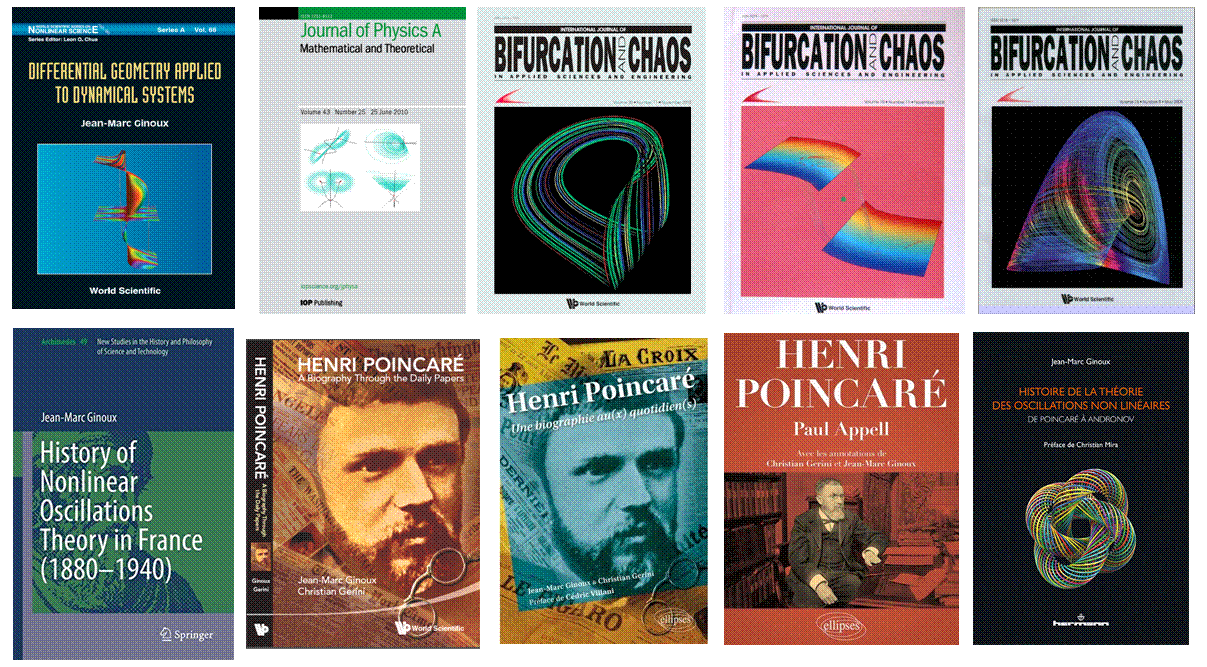
· Differential Geometry
Applied to Dynamical Systems, J.M. Ginoux
World Scientific
Series on Nonlinear Science, series A,
Vol. 66, April 2009, with CD Rom, pp. 340.
· Flow
curvature manifolds for shaping chaotic attractors: I Rösslerlike
systems, J.M. Ginoux & C. Letellier
Journal
of Physics A: Mathematical and Theoretical, 42(28), 285101 (2009).
|
2008 |
· Slow Invariant
Manifolds as Curvature of the Flow of Dynamical Systems, J.M. Ginoux,
B. Rossetto & L. Chua
International
Journal of Bifurcation & Chaos, 11, Vol. 18, pp. 3409-3430, (2008).
· Application de
Accreditation to Supervise Research,
Université du Sud, 19 juin 2008.
|
2007 |
· Invariant
Manifolds of Complex Systems, J.M. Ginoux
& B. Rossetto
Complex Systems and Self-organization Modelling, Understanding
Complex Systems.
Springer-Verlag, Heidelberg, (2007)
|
2006 |
· Differential Geometry
and Mechanics Applications to Chaotic Dynamical Systems, J.M. Ginoux
& B. Rossetto
International
Journal of Bifurcation & Chaos, 4, Vol. 16, pp. 887-910, (2006).
· Dynamical
Systems Analysis Using Differential Geometry, J.M. Ginoux
& B. Rossetto
Complex Computing-Networks, Series: Springer
Proceedings in Physics, Vol. 104, (2006)
· Slow Manifold of
a Neuronal Bursting Model, J.M. Ginoux & B. Rossetto
Emergent
Properties in Natural and Artificial Dynamical Systems, Understanding
Complex Systems.
Springer-Verlag, Heidelberg, (2006)
|
2005 |
· Chaos in a three dimensional Volterra-Gause model of predator-prey type, J.M. Ginoux,
B. Rossetto & J.L. Jamet
International
Journal of Bifurcation & Chaos, 5, Vol. 15, pp. 1689-1708, (2005).
· Stabilité des
systèmes dynamiques chaotiques et variétés
singulières, J.M. Ginoux
Ph-D thesis in Applied Mathematics, Université du Sud, 28 novembre 2005.
Mention Très Honorable –
Félicitations du jury.
This gallery proposes slow manifolds of singularly or non-singularly perturbed dynamical systems of dimension 3, 4, 5,
6… and non-autonomous dynamical
systems as well as Mathematica Files which have
enabled to plot them.
In Differential
Geometry and Mechanics Applications to Chaotic Dynamical Systems, it
had been established that the flow curvature manifold directly provided the slow
manifold analytical equation of slow-fast autonomous dynamical systems of
dimension two and three, singularly
perturbed such as those of Van der Pol and Chua but also non-singularly
perturbed such as that of Lorenz.
In Slow Invariant Manifolds as
Curvature of the Flow of Dynamical Systems, the approach established in
Differential
Geometry and Mechanics Applications to Chaotic Dynamical Systems, has
been generalized to n-dimensional
dynamical systems. It has been demonstrated that the curvature of the flow, i.e., the curvature of the trajectory curves
directly provides the slow manifold
analytical equation of n-dimensional
slow-fast autonomous dynamical systems. Thus, the flow curvature method has enabled to obtain slow manifolds of many models singularly
perturbed or not of dimension 4, 5 & 6… Moreover, the flow curvature manifold invariance has
been demonstrated while using the concept of invariant manifolds introduced by G. Darboux
in 1878.
In Chaos
in a three dimensional Volterra-Gause model of
predator-prey type, a new model of predator-prey type elaborated from
the seminal works of Vito Volterra* and Giorgii
F. Gause has lead to chaotic attractor in the shape
of a snail (chaotic snail shell).
In Slow
Manifold of a Neuronal Bursting Model, application of the flow curvature
method has directly provided the slow manifold analytical equation of a
Neuronal Bursting Model (NBM).
In Invariant
Manifolds of Complex Systems, local
invariance of the flow curvature manifold analytical equation has been established in the case of
complex systems. Moreover, it has been demonstrated, under certain assumptions,
that such manifold is a local first integral.
B. History
of Sciences Poincaré’s forgotten conferences on wireless
telegraphy (Scholarpedia)
« Pour
prévoir l’avenir des mathématiques, la vraie méthode
est d’étudier leur histoire et leur état
présent. » Henri Poincaré – Science et Méthode
1908, p. 19 –


·
Enseignement
scientifique : histoire, enjeux et débats, J.M. Ginoux,
Ellipses (2019)

·
Pour en finir avec
le mythe d’Albert Einstein, J.M. Ginoux,
Hermann (2019)

·
Petites
chroniques scientifiques extraordinaires , J.M.
Ginoux, Ellipses (2019)

·
Les
Grandes Découvertes de l’Histoire de la Physique, J.M.
Ginoux, Ellipses (2018)

·
History of Nonlinear
Oscillations Theory (1880-1940), J.M. Ginoux, Springer-Verlag (2017)

·
Albert
Einstein: a biography through the Time(s), J.M. Ginoux, Hermann (2016)


·
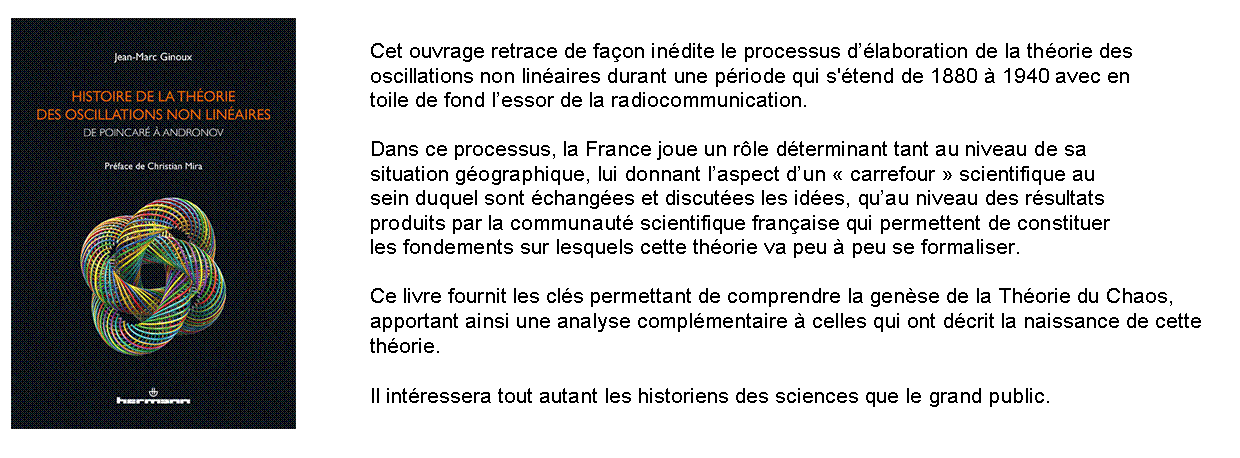
Histoire de la
Théorie des Oscillations Non Linéaires, J.M. Ginoux, forthcoming book, Hermann (2015)
Préface
Christian Mira
·
Henri Poincaré :
a biography through the daily papers, J.M. Ginoux & Ch. Gerini, World Scientific (2013)
Preface Léon Chua

·
Henri Poincaré : une biographie au(x)
quotidien(s), J.M. Ginoux & Ch. Gerini,
Éditions Ellipses (3 juillet 2012)
Préface
de Cédric Villani (Médaille Fields, 2010) et Dédicace de
Nicolas Poincaré (arrière petit-fils d’Henri
Poincaré)

·
Henri Poincaré par Paul Appell, Ch. Gerini & J.M. Ginoux,
Éditions Ellipses (décembre 2013)

|
2018 |
·
From Branly Coherer to Chua Memristor, J.M. Ginoux & T.
Cuff
Fractional
Dynamics, Anomalous Transport and Plasma Science,
Springer
International Publishing, Christos Skiadas (Ed.), (2018)
|
2017 |
· The Paradox of
Vito Volterra’s predator-prey model, J.M. Ginoux
Lettera Matematica
International, December 2017, Vol. 5(4), pp. 305-311, Springer-Milan.
|
2016 |
· From
Nonlinear Oscillations to Chaos Theory, J.M. Ginoux
The Foundations
of Chaos Revisited : From Poincaré
to Recent Advancements,
Springer
International Publishing, Christos Skiadas (Ed.), (2016)
|
2013 |
· The
Singing Arc: The Oldest Memristor? J.M. Ginoux & Bruno
Rossetto
“Chaos, CNN, Memristors and Beyond”, World
Scientific Publishing, Adamatsky A. & Chen G.
(Eds.), (2013)
|
2012 |
· Henri Poincaré et
l’émergence du concept de cycle limite, J.M. Ginoux
Quadrature, Novembre 2012, Hors-Série
n° 1, pp. 1-7.
·
Self-excited
oscillations : from Poincaré to Andronov, J.M. Ginoux
Nieuw Archief voor
Wiskunde (New Archive for Mathematics)
Royal Dutch Mathematical Society (Koninklijk
Wiskundig Genootschap), 5(13) n°3, pp.
170-177 September (2012).
· Poincaré
et la rotation de la Terre, J.M. Ginoux
& Ch. Gerini
Pour
· Blondel et les
oscillations auto-entretenues, J.M. Ginoux & R. Lozi
Archive for History of Exact
Sciences (2012): 1-46, May 17, 2012
· The First “Lost”
International Conference on Nonlinear Oscillations (I.C.N.O.), J.M. Ginoux
International Journal of Bifurcation & Chaos, 4,
Vol. 22, pp. 3617-3626, (2012) 1250097 (8 pages).
·
Van der Pol and the history of
relaxation oscillations: Toward the emergence of a concepts,
J.M. Ginoux
& C. Letellier, Chaos 22, 023120
(2012); http://dx.doi.org/10.1063/1.3670008 (15 pages)
|
2011 |
· Analyse
mathématique des phénomènes oscillatoires non
linéaires, J.M. Ginoux
Ph-D thesis in History of Sciences,
Université Pierre & Marie Curie, 15 mars 2011 à l’Institut Henri Poincaré
Mention Très Honorable.
|
2010 |
· Poincaré’s forgotten conferences on wireless telegraphy, J.M. Ginoux
& L. Petitgirard
International
Journal of Bifurcation & Chaos, 11, Vol.
20, pp. 3617-3626, (2010).
|
2009 |
· Development of the nonlinear dynamical systems theory from radio
engineering to electronics,
C. Letellier & J.M.
Ginoux
International
Journal of Bifurcation & Chaos, 7, Vol. 19, pp. 2131-2163, (2009).
·
Mathematics
in 1st year of Génie Mécanique et Productique
·
Ph-D in Applied
Mathematics (2005), Université de Toulon, Laboratoire PROTEE
·
Accreditation to supervise research in Applied
Mathematics (2008), Université de Toulon, Laboratoire PROTEE
·
Ph-D in History
of Sciences (2011),
Université Pierre & Marie Curie, Paris VI, Institut de
Mathématiques de Jussieu.
Senior lecturer in Mathematics at
Mechanics Engineering Department